
Rethinking Mandarin Dual Language Immersion: Why the Best Programs Don't Translate the Curriculum
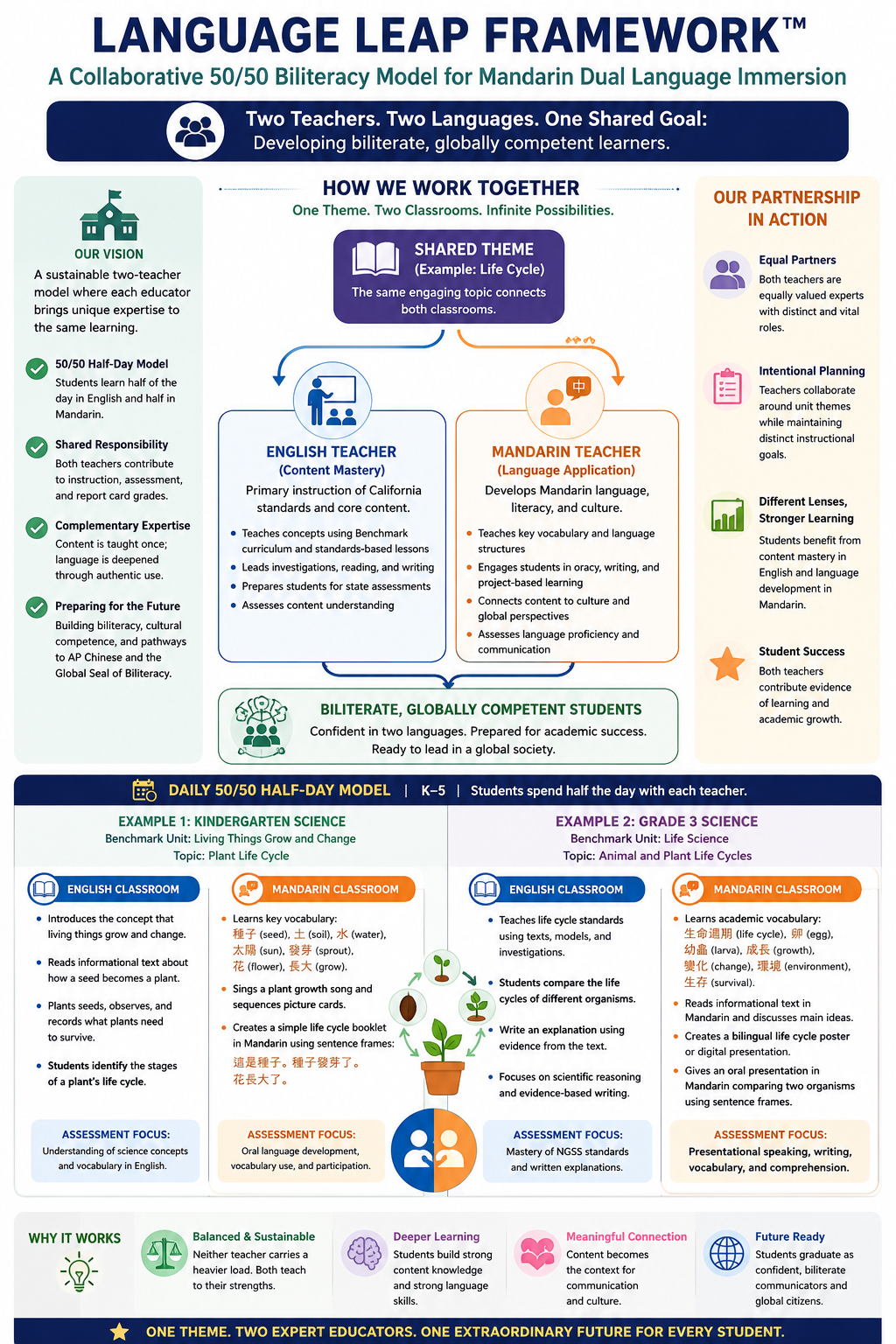
Language Leap Framework™
When school districts design a Mandarin Dual Language Immersion (DLI) program, one of the first questions they ask is:
"Which teacher teaches which subject?"
Traditionally, the answer has been simple: divide the instructional day by language. The English teacher teaches part of the curriculum, and the Mandarin teacher teaches the other half. In many programs, this means the Mandarin teacher is responsible for delivering core academic content—including mathematics, science, and social studies—in the target language.
While this model has been successful in many settings, it also creates a challenge that districts across the country are beginning to recognize: teacher sustainability.
The Hidden Challenge of Traditional Immersion Models
In many 50/50 immersion programs, the Mandarin teacher is expected to be:
A world language teacher.
A literacy specialist.
A science and social studies teacher.
A curriculum adapter and translator.
A cultural ambassador.
A creator of original instructional materials.
At the same time, the English teacher often carries the responsibility for English Language Arts and state testing preparation.
The result is that one teacher may unintentionally shoulder a disproportionate amount of curriculum development and planning. This can contribute to burnout, make recruitment more difficult, and create inconsistencies across classrooms.
But what if we stopped thinking about immersion as a division of subjects and started thinking about it as a partnership of expertise?
A Different Approach: One Theme, Two Expert Educators
At Language Leap Consulting, we believe that successful dual language programs should not be built on duplicated instruction or direct translation. Instead, they should be built on shared responsibility and complementary expertise.
In the Language Leap Framework™, both teachers work with the same group of students and both contribute to student assessment and report card grades. However, each teacher brings a different instructional lens.
The English teacher serves as the primary content expert.
Introduces California standards-based concepts.
Leads instruction using district-adopted curriculum.
Prepares students for state assessments.
Assesses content mastery.
The Mandarin teacher serves as the biliteracy and intercultural communication expert.
Develops Mandarin literacy and academic vocabulary.
Strengthens listening and speaking through authentic communication.
Connects learning through project-based experiences.
Builds cultural competence and global awareness.
Assesses language proficiency and application.
In this model, students do not learn the same lesson twice. Instead, they deepen their understanding by exploring the same theme through two complementary learning experiences.
What Does This Look Like in Practice?
Imagine a Kindergarten science unit on the plant life cycle.
During the English block, students learn the scientific concepts. They plant seeds, observe growth, read informational texts, and identify the stages of a plant's development.
During the Mandarin block, students use those same concepts to build language. They learn vocabulary such as 種子 (seed), 發芽 (sprout), and 花 (flower). They sing songs, sequence picture cards, create a simple life cycle booklet, and practice speaking using complete sentences in Mandarin.
Science is taught once, but the learning is strengthened through authentic language application.
Now imagine that same progression in third grade.
Students learn life cycle standards through Benchmark and NGSS-aligned lessons in English. Then, in Mandarin, they read short informational texts, engage in structured academic discussions, create bilingual projects, and deliver oral presentations comparing the life cycles of different organisms.
The English classroom develops scientific understanding. The Mandarin classroom transforms that understanding into opportunities for communication, literacy, and global thinking.
Why This Matters for Student Outcomes
This collaborative approach offers several important benefits:
Stronger Biliteracy Development
Students use Mandarin for authentic communication rather than memorization or isolated vocabulary practice. Language becomes a tool for thinking, creating, and sharing ideas.
Balanced Teacher Workload
Both educators contribute meaningfully to student success while working within clearly defined areas of expertise. This creates a more sustainable model for staffing and retention.
Improved Alignment with State Standards
The English classroom remains the anchor for California standards and accountability measures, while the Mandarin classroom enriches and extends learning without sacrificing instructional quality.
A Clear Pathway to Global Competence
Students are not only learning another language—they are developing the communication, collaboration, and intercultural skills necessary to thrive in an increasingly connected world.
The Future of Mandarin Dual Language Immersion
The question for districts should no longer be, "Which teacher owns science?" or "Which teacher teaches social studies?"
A more powerful question is:
"How can two expert educators work together to create one seamless, meaningful learning experience for every child?"
At Language Leap Consulting, we believe the future of dual language education lies in collaboration rather than duplication. By building programs around shared themes, balanced teacher responsibilities, and authentic language application, districts can create sustainable immersion models that support educators while preparing students to become biliterate, globally competent leaders.
One Theme. Two Expert Educators. One Shared Goal: Developing Biliterate, Globally Competent Learners.
About Language Leap Consulting
Language Leap Consulting partners with schools and districts to design and strengthen Mandarin Dual Language Immersion programs, biliteracy pathways, curriculum alignment, and professional development systems. Our mission is to help schools build sustainable, equitable, and innovative language programs that prepare students for success in a global society.
Interested in reimagining your district's Mandarin immersion model? Contact Language Leap Consulting to learn more about the Language Leap Framework™.
By Joanna Graham - Language Leap Consulting
